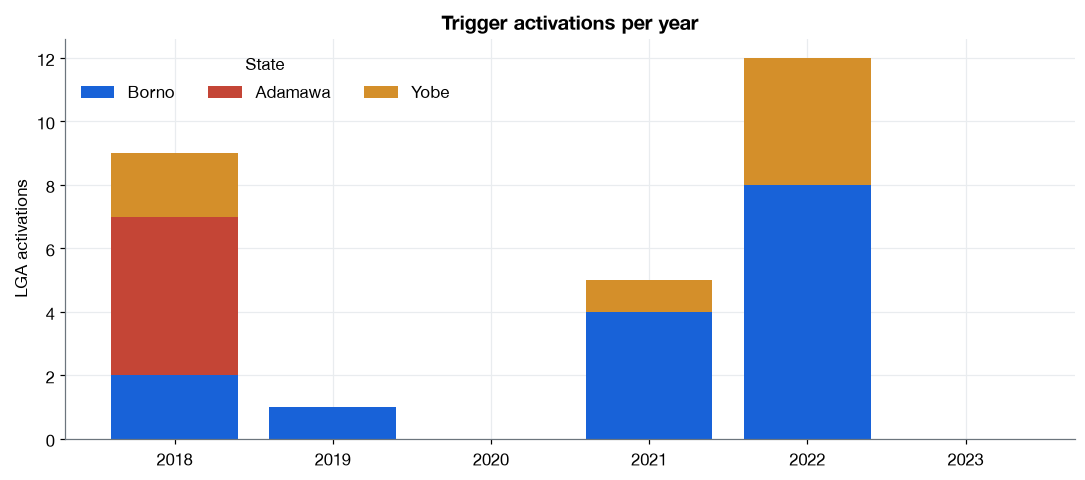
If the candidate trigger were run over 2018–2023, how often would it have fired, where, and what return period does that imply? Frequency is what links a trigger to a funding envelope.
Figure 5.1: LGA-year activations per year, coloured by state. Firing concentrates in the outbreak years; 2020 and 2023 produce none (2020 has no data, 2023 is truncated).
Table 5.1: LGAs by number of activations over 2018–2023. Priority LGAs are marked.
LGA
State
Activations
Years
Priority LGA
Damaturu
Yobe
3
2018, 2021, 2022
False
Bama
Borno
2
2019, 2022
True
Gujba
Yobe
2
2018, 2022
False
Konduga
Borno
2
2021, 2022
False
Jere
Borno
2
2021, 2022
False
Fika
Yobe
1
2022
False
Fufore
Adamawa
1
2018
False
Dikwa
Borno
1
2022
True
Gulani
Yobe
1
2022
False
Gwoza
Borno
1
2021
False
Bayo
Borno
1
2022
False
Chibok
Borno
1
2018
False
Mafa
Borno
1
2021
False
Magumeri
Borno
1
2018
False
Maiha
Adamawa
1
2018
False
Across the period the trigger produces 27 LGA-year activations in 21 distinct LGAs. Most LGAs fire in a single outbreak year; a few (Damaturu, Bama, Jere, Konduga, Gujba) fire in more than one.
5.3 Implied return period
A crude return period divides the LGA-years observed by the activations seen. Because 2020 is a data gap, we compute it two ways: over all six years, and over the four well-reported years (2018, 2019, 2021, 2022).
Show code
def rp(years): a = act[act["year"].isin(years)] lga_years = n_lgas *len(years) rate =len(a) / lga_yearsreturnlen(a), lga_years, rate, (1/ rate if rate else np.nan)rows = []for label, yrs in [ ("All years (2018–2023)", list(range(2018, 2024))), ("Well-reported yrs (2018,19,21,22)", [2018, 2019, 2021, 2022]),]: a, ly, rate, per = rp(yrs) rows.append([label, a, ly, f"{rate:.3f}", f"~1 in {per:.0f} LGA-years"])rpt = pd.DataFrame(rows, columns=["Exposure window", "Activations", "LGA-years", "Activation rate", "Return period"])rpt.style.hide(axis="index")
Table 5.2: Implied per-LGA return period under two exposure assumptions. Excluding the 2020 gap year gives the more honest figure.
Exposure window
Activations
LGA-years
Activation rate
Return period
All years (2018–2023)
27
330
0.082
~1 in 12 LGA-years
Well-reported yrs (2018,19,21,22)
27
220
0.123
~1 in 8 LGA-years
Read the return period per-LGA: roughly 1 activation per 12–15 LGA-years — i.e. a given LGA triggers about once a decade, but with 55 LGAs in scope the system fires several times in any real outbreak year. That is the tension a framework has to price: the per-LGA event is rare, but the portfolio-wide event (at least one LGA firing somewhere in BAY in a bad year) is close to annual.
5.4 Priority-LGA focus
The earlier exploration designated four priority LGAs — Bama and Numan (priority-1), Dikwa and Ngala (priority-2). How does the trigger behave if scope is narrowed to just these?
Show code
prio_act = act[act["ADM2_PCODE"].isin(U.PRIORITY_LGAS)].copy()iflen(prio_act): p = prio_act[["ADM2_EN", "state", "year", "week", "cases"]].sort_values("week") p["week"] = p["week"].dt.date p.columns = ["LGA", "State", "Year", "Activation week", "Cases that week"] display_p = p.style.hide(axis="index")else: display_p ="No activations in the four priority LGAs under the baseline trigger."display_p
Table 5.3: Activations restricted to the four priority LGAs.
LGA
State
Year
Activation week
Cases that week
Bama
Borno
2019
2019-07-15
90
Dikwa
Borno
2022
2022-09-26
397
Bama
Borno
2022
2022-10-03
189
Ngala
Borno
2022
2022-10-10
347
Restricting to the four priority LGAs yields 4 activations over the period. A priority-only trigger is far quieter — which controls cost, but at the risk of missing high-burden non-priority LGAs (e.g. the Maiduguri-area and Yobe LGAs that dominate the burden map). The priority-LGA rationale was never documented in the earlier work and deserves an explicit, burden-based justification before it anchors a framework.